
Now Reading: Did you know? This village near Vizag is home to India’s first highest broad gauge railway station
-
01
Did you know? This village near Vizag is home to India’s first highest broad gauge railway station
Did you know? This village near Vizag is home to India’s first highest broad gauge railway station
For most Vizagites, a trip to Araku Valley is a cherished escape. With its cool climate, green coffee plantations, cascading waterfalls, mysterious caves, and sweeping hilltop views, Araku has long been a favourite getaway. While the destination is as enchanting as can be, the journey here — especially by train — is even more beguiling.
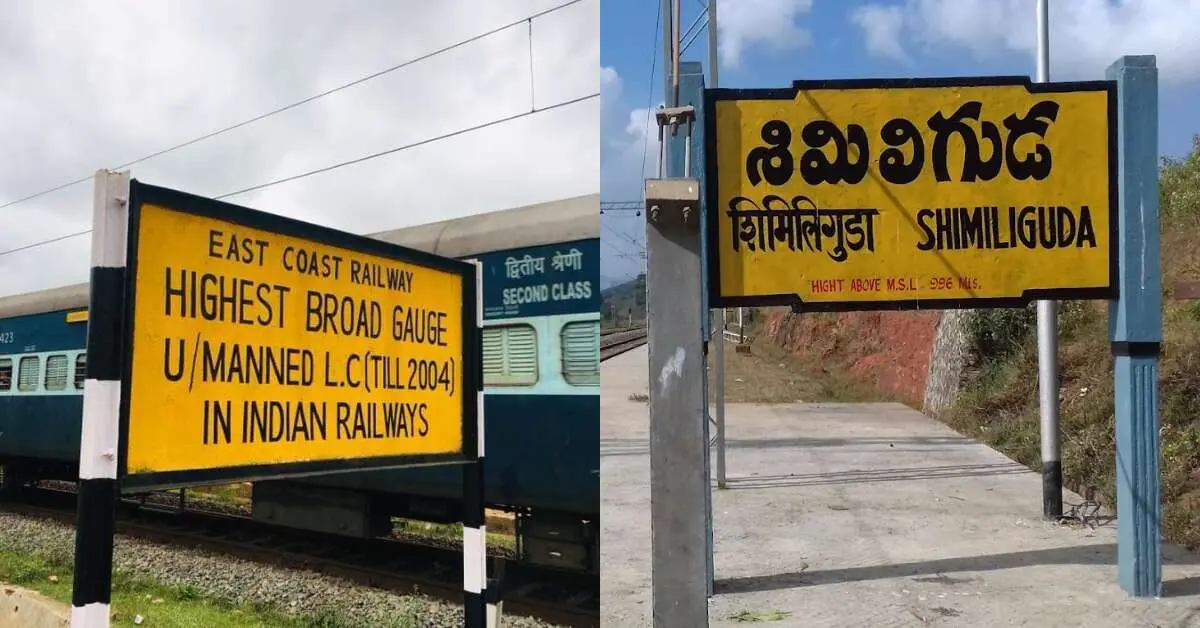
The Visakhapatnam-Kirandul Passenger train, famously scenic, takes you to Araku through 58 tunnels and 84 bridges, weaving through the dramatic Anantagiri hills. Along the way, you’ll even pass Borra Caves (famously deep limestone caves). However, one of the most remarkable yet overlooked stops is a little village called Shimiliguda which once made railway history. If you pay enough attention as your train slows at the station, you’ll notice a signboard that pays homage to its accomplishment… “Highest Broad Gauge Station (Till 2004) on Indian Railways”!
Yes, sitting at an altitude of 997 meters (3,271 feet) above sea level, Shimiliguda Railway Station was in fact India’s first highest broad gauge railway station – a record it retained until 2004 when Qazigund station (1670 metres above sea level) was built in Jammu & Kashmir. The 58501/02 Visakhapatnam-Kirandul train halts here, along with heavy freight traffic, mainly iron ore carriers.

Image credits: Bishnu Mohan Adhikari (@VAdkri on X)
A Marvel of Engineering
Shimiliguda sits on the Kothavalasa-Kirandul Line (KK Line), an engineering marvel built between 1960 and 1968 with support from the Japanese government. The line was originally intended to transport iron ore from the Bailadila mines in present-day Chhattisgarh to Visakhapatnam Port, from where it would be exported to Japan.
Cutting through rugged terrain and the dense Eastern Ghats, the line remains one of Indian Railways’ most challenging construction feats, with its 58 tunnels and 84 major bridges a testament to the ambitious vision behind it.
What Is a Broad Gauge Railway?
Shimiliguda Railway Station was built with broad gauge rails. A gauge refers to the distance between the inner sides of two parallel tracks. Broad gauge — also known as wide gauge — has a width of 1,676 mm (5 feet 6 inches), offering better stability and load capacity compared to narrower gauges. It’s the most widely used gauge in India and is commonly found at ports and on major routes. India’s first railway line, between Bore Bunder (now CST) and Thane in 1853, was built on broad gauge.
Shimiliguda, India’s first highest broad gauge railway station, is about 107 km from Vizag. The most scenic and memorable way to visit is by hopping on the Vizag-Kirandul train. If you’re lucky enough to get down and explore, Shimiliguda Lake — a beautiful, calm, and untouched spot — is just 3 km away. From the station, Araku town is only 8 km away, and you can easily find autos to take you there.
Stay tuned to Yo! Vizag website and Instagram for more such articles.