
Now Reading: Lost in Time: 10,000 Year Old Ancient Rock Paintings near Vizag
-
01
Lost in Time: 10,000 Year Old Ancient Rock Paintings near Vizag
Lost in Time: 10,000 Year Old Ancient Rock Paintings near Vizag
Visakhapatnam’s heritage has been explored, written about, and visited time and again. From Buddhist relics to colonial traces, the region has revealed stories carved over centuries. But history doesn’t always begin where we think it does. Sometimes, we can find signs of it that long predate temples and stupas.
Roughly 150 kilometres from Vizag, in the rugged hillocks of Srikakulam, lies a site that goes back nearly 10,000 years. A place where humans, long before kings and kingdoms, painted their existence onto stone, with nothing but red ochre as their canvas.
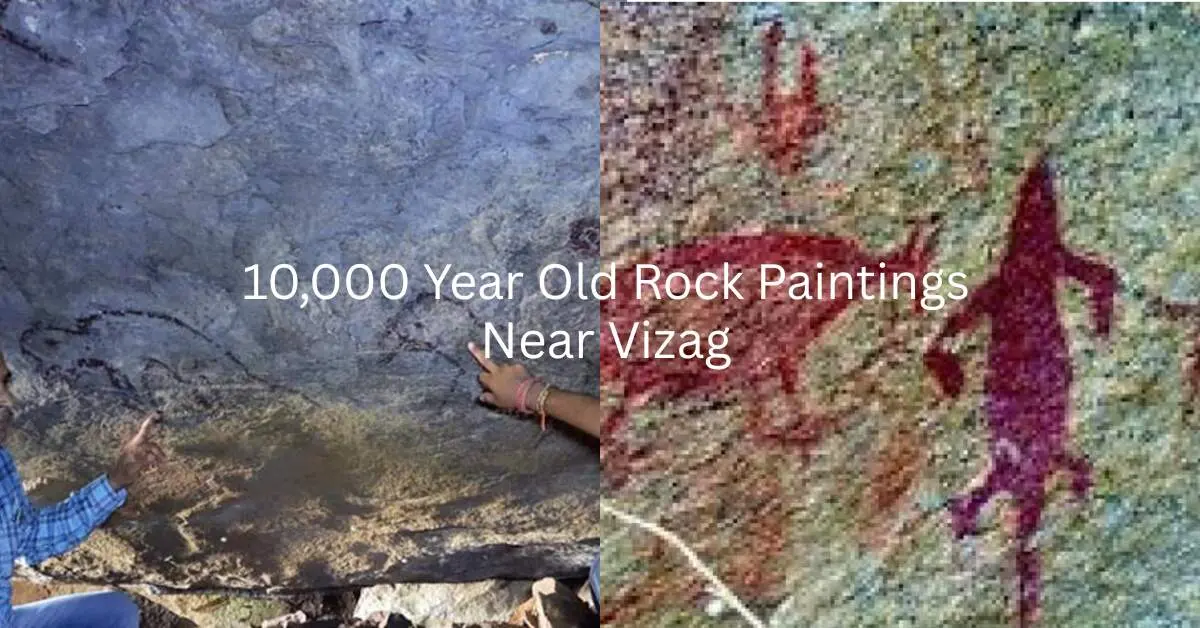
This site, known as Jogulamba Metta near Kondatemburu village of Nandigam Mandal, is one of the earliest visual records of human life in this region. It is home to rock paintings that are estimated to be 10,000 years old!
The Discovery

The team of archaeologists who did the excavation – Image Source: Times of India
The discovery of this site is relatively recent. In August 2022, officials from the Andhra Pradesh State Archaeology Department documented these ancient rock paintings following information shared by a local resident named Ramana Murthy.
The team, led by Assistant Director S Venkata Rao, was able to authenticate the presence of multiple well-preserved paintings, along with other archaeological evidence that confirmed the prehistoric nature of the site. Their findings were significant enough to be forwarded to the Commissioner of Archaeology with a recommendation for official protection under the provisions of the Archaeological Remains Act, 1960.
What is known about the site?
The ancient rock paintings are painted with red ochre pigment, a material widely used by tribal communities around Vizag and India to decorate the outer walls of their homes. The ancient rock painting found in Srikakulam depicts a variety of animals and scenes that offer insight into the ecosystem and life patterns of the people who lived here thousands of years ago.

Images of ancient rock paintings in Srikakulam depicting boar, Peacock and other animals – Image Source: Times of India
Among the most prominent figures are elephants with calves, peacocks with striking tail displays, boars, rhinoceroses, monkeys, and rabbits. Human figures are also present, drawn with simplicity yet clarity, offering a glimpse into the artistic expressions of early hunter-gatherer communities.
In addition to the painted imagery, archaeologists also noted the presence of numerous cup-marks, which are also known as cupules (depressions carved into the floor of the rock shelters). These are often interpreted by researchers as having ritualistic significance, potentially connected to burial practices or spiritual beliefs of the time. The site also contained solid evidence of prehistoric tool-making, including clusters of quartzite nodules (Hard rocks which are used for tool-making), suggesting that this location was an active site for daily survival activities.

Example Image for Cup Marks and quartzite nodules (Just for reference)
The timeline of the paintings has been made based on art comparisons with similar rock art sites across India, the consistent use of red ochre pigments, and the association with lithic tools found in situ, experts have placed these paintings in the Upper Palaeolithic to Mesolithic periods, estimated to be between 15,000 and 10,000 years old.
This discovery is not an isolated phenomenon in this region. Nearby, at Thene Konda within the same mandal, other prehistoric paintings featuring lizards and deer have been documented, further strengthening the belief that this area was a significant cultural and settlement hub for early human populations in this part of the subcontinent.
How to get there from Vizag
For travellers intrigued by history or by the idea of witnessing humanity’s earliest forms of expression, the site is located approximately 167 km from Visakhapatnam and can be reached by road. It takes approximately three to four hours to reach via Srikakulam town. Though the site is open and accessible, it lacks formal tourist infrastructure.
Travellers are advised to plan their visits during daylight hours, as the hillocks have no artificial lighting and navigating the area after dark can be unsafe. Since the site currently lacks protective measures such as fencing, signage, or ticketing systems, it remains crucial for visitors to tread carefully and responsibly to preserve the integrity of the paintings.
For more information regarding the visit, you should check with the local MRO officials. You can contact them at 83339 88795
Despite the archaeological importance of these ancient rock paintings near Vizag, the site is yet to be officially recognised as a protected monument, and efforts are ongoing from the archaeology department to secure its conservation.
Stay tuned to Yo! Vizag website and Instagram history-related content.