Now Reading: Vizag’s Little-Known Toy Trains!
-
01
Vizag’s Little-Known Toy Trains!
Vizag’s Little-Known Toy Trains!
When one hears the phrase “toy trains of India,” it’s usually the famed mountain railways like the Darjeeling Himalayan Railway or Nilgiri Mountain Railway that flash through the mind. Exuding vintage glory, these little locomotives win the fancy of anyone who gazes upon them. But for Vizagites, it is time to turn their attention to their very own slice of miniature railway history. Yes, Visakhapatnam once had toy trains of its own, cheerfully choo-chooing away! In fact, these toy trains laid the very tracks for the success of the Visakhapatnam Port!
Today, a trinket of this era is still stationed in the city. What is the story of these little-known toy trains of Visakhapatnam? How did they come to be, and how did they disappear? History aficionado John Castellas chugs down the tracks of time and charts out the past to give us the answer:
Have you ever passed by the Visakha Naval Museum or seen images of a solitary toy train engine on display outside? Have you ever wondered what the relevance of that display is about?

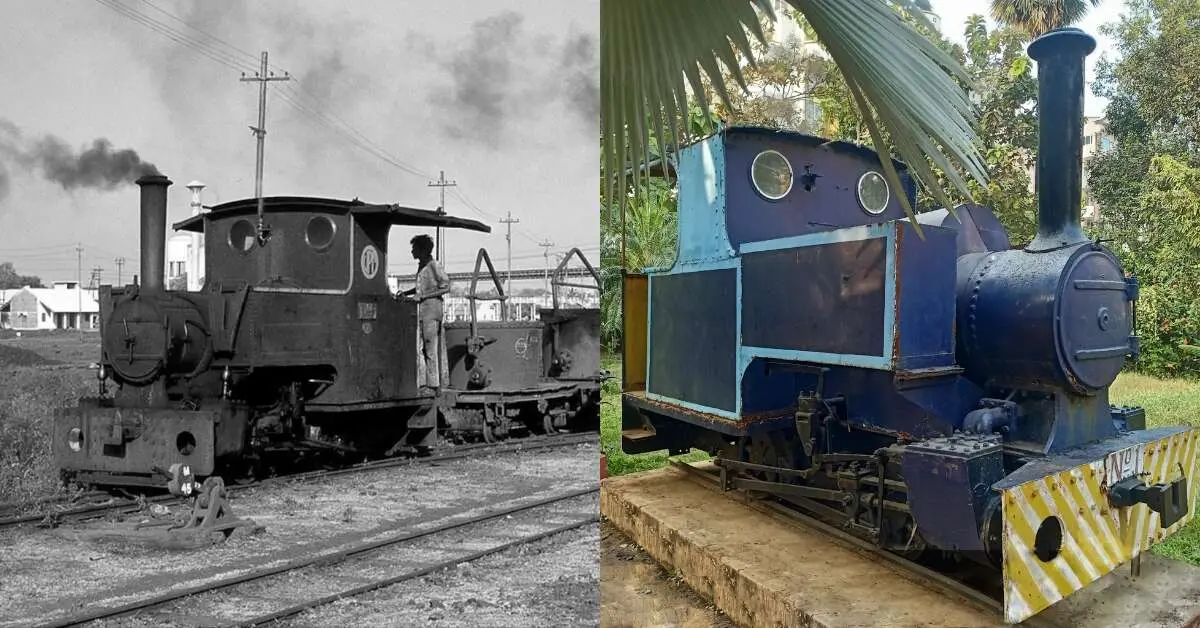
VPT Bagnall Locomotive No 1, Visakha Naval Museum; then (1933) & now (2024)
It starts with the discovery of manganese ore in the Central Provinces (Madhya Pradesh) and in northern parts of Andhra in the late 1800s that accounted for 80% of India’s export of manganese as it became the essential alloying element for the world’s newer high strength steels. After 100 years of debate and many alternative schemes, a proposal for the construction of a harbour at Visakhapatnam (then known as Vizagapatam) was put forward in 1914 by the Bengal-Nagpur Railway (BNR). In 1916, a proposal by the British Admiralty for a harbour at the mouth of the Maghadrigedda (Meghadri Gedda) waterway was accepted. The Inner Harbour was built by the BNR between 1927 and 1933 to help the export of manganese ore from the Central Provinces. The port opened in 1933 and was inaugurated by Lord Willingdon, the then Viceroy of India. This Bagnall 0-4-0T steam locomotive was part of the new Vizagapatam Port Toy Train railway network.

Vizagapatam Port Opening Commemorative Plaque
The Central Provinces Manganese Ore Company, a British-owned concern operated 22 mines scattered throughout a belt 120 miles (about 200 km) long by 10 miles (about 20 km) wide, extending through Nagpur, Balaghat, and Bhandara districts. They produced 80 per cent of the manganese ore shipped from Madhya Pradesh. The Vizianagram Mining Company operated manganese mines in Andhra at about the same time.
Visakhapatnam was constructed as the chief port for manganese ore shipments, and it was equipped with an artificial land-locked harbour, which is approached through a narrow dredged channel. In the port were three quay berths, of which Nos. 1 and 2 were equipped for the handling of manganese ore. The quay berths were equipped with six 3-ton level luffing electric cranes. Three 2 feet – 6 inch (762 mm) narrow gauge switching Bagnall locomotives at the port were used for hauling the manganese ore from the dumps to the ship-side. Two of these locomotives and four cranes served the No. 1 berth, and one locomotive and two cranes served the No. 2 berth.

Loading manganese on ships with quay-side cranes
The Bengal Nagpur Railway (BNR) built the rail line between Nagpur and Vizag for the bulk transport of manganese ore and within the port constructed a narrow-gauge network on which the port locomotives ran. Manganese was brought down in trainloads from the mines, and the rail cars were unloaded by coolie labour into long stocking zones along the ore sidings behind the dock area. Dumping space for approximately 100,000 tons of manganese ore was provided. The blending of ores from different mines was done by unloading the ore trains from various mines in layers on the long piles paralleling the sidings.
The toy trains were an essential part of the Vizag Port Trust (VPT) infrastructure for transporting and loading manganese and coal for the town’s first powerhouse too. The port was originally served by the narrow-gauge rail network that was gradually extended—VPT owned and operated about 200 km of track length. Demands for higher loading capacity led to modern overhead conveyor handling and the narrow-gauge network ceased operation in 1986.

Visakhapatnam Port Trust narrow-gauge rail network
The ore was loaded onto ships by cars (bogies) carrying round ore buckets, which ran on 2 feet – 6 inch tracks between the stockpiles and the docks. The bogies were located along the ore piles and were loaded by coolies. The switching locomotives then transported the bogies to the ship-side, where the buckets were picked up from the bogies by dock cranes or ship tackle and dumped into the ship’s holds.

Operational Bagnall Locomotives with Bogies and Buckets at Vizag Port, modern overhead handing in the background.
W G Bagnall (a locomotive manufacturer from Stafford, UK) built the narrow gauge Steam Locomotive No 1 (0-4-0T) of the Visakhapatnam Port Trust (VPT) photographed running in 1979. Now displayed at the Visakha Naval Museum on Vizag’s Beach Road, Waltair, this locomotive was built in 1932 and now stands as a silent testament to the founding days of the modern Vizag Port and the prosperity that came to the city with the export of manganese and other ores.
Written by John Castellas whose family belonged to Vizag for 5 generations. Educated at St Aloysius, migrated to Melbourne, Australia in 1966, former General Manager Engineering at Boeing & Qantas Airways, in retirement Lecturers in Aviation Management at Swinburne University and is a Vizag aficionado. He can be contacted at [email protected]
Stay tuned to Yo! Vizag website and Instagram for more heritage articles.