Now Reading: When the Sea Roads led to Vizag
- 01
When the Sea Roads led to Vizag
When the Sea Roads led to Vizag
The Indian Navy’s International Fleet Review in February 2026 at Visakhapatnam on India’s east coast will highlight the Eastern Command to the navies of over 50 countries and will be presided over by the President of India. The shores of India’s east coast date back to antiquity, and a maritime tradition that preceded the advent of humans and sailing ships of the Egyptian, Babylonian, and Greek civilisations of that era.
First Recorded Maritime Activity in India:
As early as the 2nd millennium BCE, trade and migration networks extended across the Bay of Bengal from India’s east coast. The earliest maritime activity is recorded in India’s most ancient text – the Upanishad, where Varunah, the presiding deity of the oceans, is credited with the knowledge of maritime routes and exploits of ancient navies. It is not surprising that the motto for today’s Indian Navy is the Sanskrit phrase ‘Sham No Varunah,’ which translates to ‘May the Lord of Water be auspicious unto us.’ This phrase, derived from the Taittiriya Upanishad, reflects the Navy’s deep respect for the ocean and its vital role in safeguarding India’s maritime interests and supporting stability in the region.
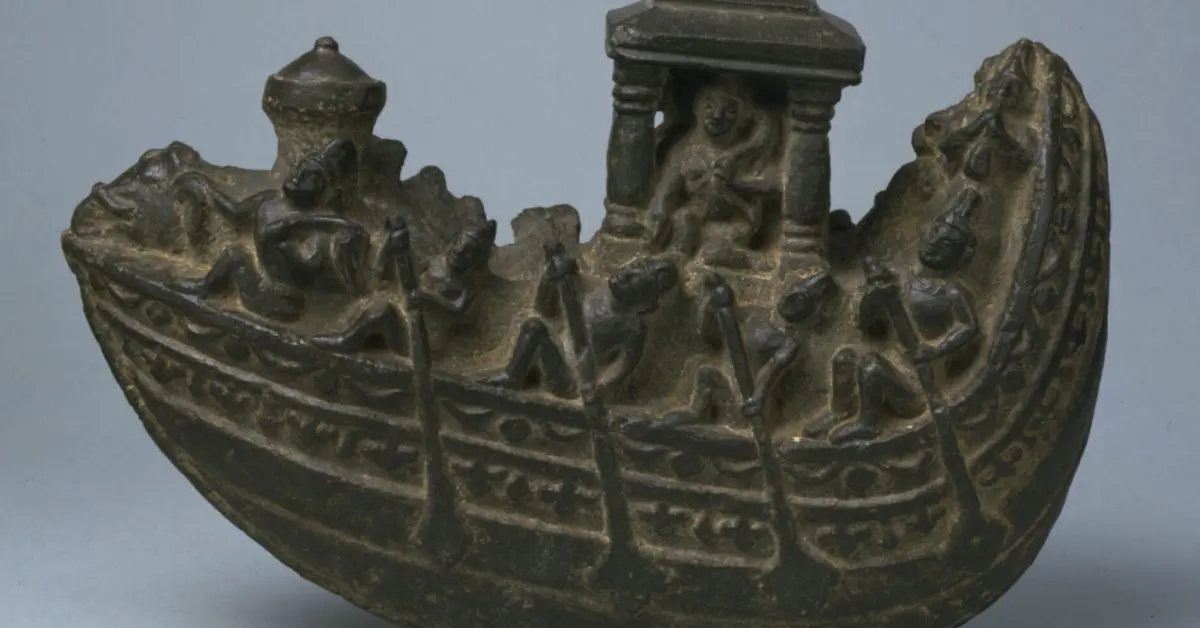
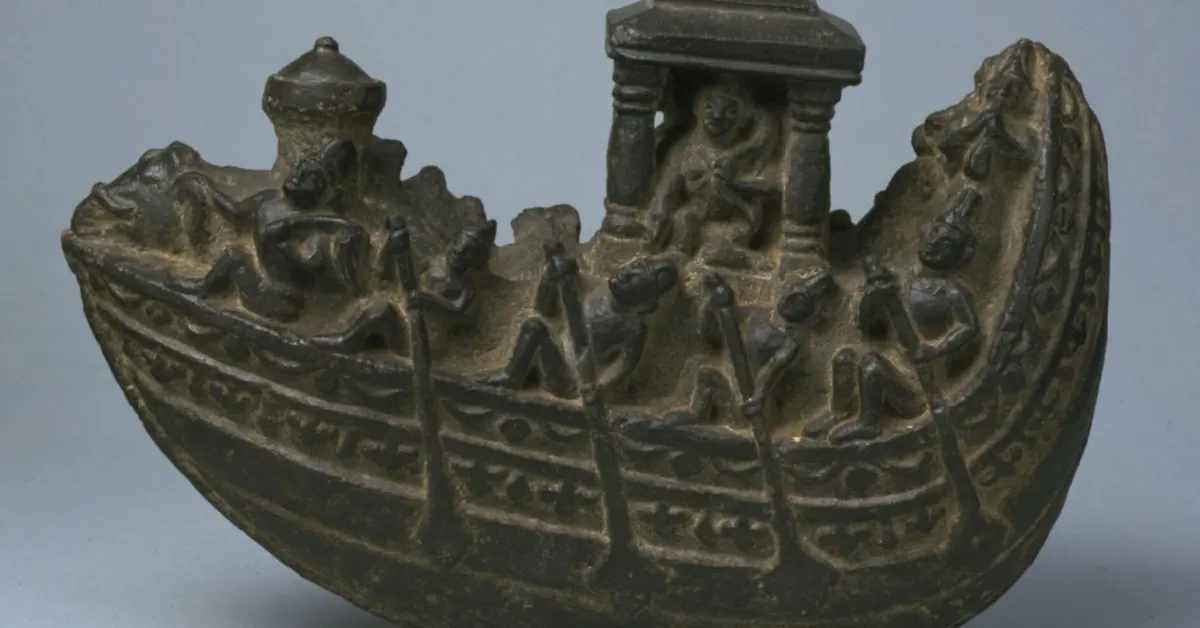
Stone Model of the 2nd Millennium BCE, India, East Coast vessel (V & A Museum, London)
India’s maritime heritage is depicted in many rock carvings and inscriptions, and this 2nd Millennium BCE stone model from India’s east coast is an example of a ceremonial vessel or royal barge. It depicts a sea-going vessel with a clinker-built high stern and elaborate decoration on its upper planks. With six to eight helmsmen and rowers, a pavilion shelters a regal figure facing the bow, on the port side a warrior with a bow and on the starboard a priest carries prayer beads. A kneeling elephant and attendant rest on the bow.
Vizag Through History:
Rulers over many early Indian dynasties recognised the potential of the east coast seas for trade, commerce, cultural and religious exchanges. The original Maritime Silk Roads passed through this region. This route was also influential in the early spread of Hinduism and Buddhism to the east. The close links of this region to trade with South Asia led to the widespread adoption of Sanskrit as the trade lingua franca in the early Maritime Silk Road of the 4th century BCE.
The Satavahana (2-3rd Millennium BCE), the Pallavas (3-9th century CE), the Kalingas (5-10th century CE), followed by the Cholas, with the coastline being known as Chola Mandalam, and the Pandayas (14th century CE). In 1498, the Portuguese explorer Vasco da Gama landed in Calicut (Kozhikode), and the Dutch, French, Danish and English followed to set up trading outposts that led to colonial empires that played out the conflicts of Europe on the Indian sub-continent and suppression of the local people. The great Mughal empire that ruled India at this time was powerless without a navy and eventually faded. The French ‘Compagnie des Indes Orientales’, the Dutch ‘Vereenigde Oostindische Compagnie’, the Danish ‘Ostindisk Kompagni’ and the ‘English East India Company’ all established trading companies and outposts called Factories (staffed by Factors or clerks) to buy and export commodities like spices, cotton, silk and tea. They maintained standing armies, constructed fortifications, and pursued territorial expansion. Vizagapatam was one such Factory town, and a garrison for the Madras Infantry Regiment. With time and the construction of the Inner Harbour in 1933, the fledgling INS Circars was established.
Tales of the Sea:
In an era, when valiant sea voyages by sail were the norm, India’s east coast and the Bay of Bengal were mapped with sea roads and the colonists recorded Vizagapatam Roads as an anchorage when sheltered harbours were unheard of, and the skill of the east coast fishermen in their manual boats rode the treacherous surf to transfer people and cargo from ship to shore. Chola Mandalam (Realm of the Cholas) was mapped as the Coromandel Coast. The Nizam of Hyderabad ceded the ‘sircars’ or regions, which were mapped as the Northern Circars of the Madras Presidency. An interesting byproduct of these times was the shipment of indentured mass labour across the Bay of Bengal to cultivate the sugarcane plantations of Fiji, rubber of Malaya, oil and rice of Burma, coffee of Kenya, sugarcane of Mauritius, South Africa and the West Indies, influencing the destinies of those regions forever.
One City, Many Names!
When INS Circars in Visakhapatnam hosts the International Fleet Review, visiting sailors may wonder about its name. From Vizagapatam to Visakhapatnam, Vysagepatnam (Dutch), Gyngerlee (first English use), Vizagapatam (English), Visigapatam (French), Visagapatnam (French), Visag, Vifagapatnam (old English), Vizipatan (Dutch), Visippatam (Portuguese), Visapatam (Portuguese), Vizacapatnam, Vizigapatum, Upputeru (Telugu), Kolotungapatnam, Kulottunga Chola Patnam (Temple Inscriptions), Ishakapatnam (Mosque records), Visakha (Buddhist Ghatas 5-6th century BCE) are among the names in recorded history. Modern branding gurus will claim that names should be distinctive, short, appropriate, easy to spell and pronounce, likeable, extendable, and catchy. What better for the tongue-twisting modern town of five syllables – VIZAG! To the navies of the world – Sham No Varunah and Welcome to Vizag!
Written by John Castellas whose family belonged to Vizag for 5 generations. Educated at St Aloysius, migrated to Melbourne, Australia in 1966, former General Manager Engineering at Boeing & Qantas Airways, in retirement Lecturers in Aviation Management at Swinburne University and is a Vizag aficionado.
Stay tuned to Yo! Vizag website and Instagram for more Vizag heritage articles.