Now Reading: 8 wildly interesting facts about the sinking of PNS Ghazi during the 1971 Indo-Pak war in Vizag!
- 01
8 wildly interesting facts about the sinking of PNS Ghazi during the 1971 Indo-Pak war in Vizag!
8 wildly interesting facts about the sinking of PNS Ghazi during the 1971 Indo-Pak war in Vizag!
The Indo-Pakistani War of 1971, also known as the Third Indo-Pak War, was fought between India and Pakistan during the Bangladesh Liberation War. The conflict began on 3 December 1971 and ended just 13 days later, on 16 December, with Pakistan’s surrender in Dhaka and the creation of Bangladesh.
The city of Visakhapatnam played a crucial role in the 1971 Indo-Pak war, as it was off this very coast that PNS Ghazi, a Pakistani submarine, met its mysterious and dramatic end. But not everyone knows the full extent of the story, and you might be surprised by these 8 wildly interesting facts about this historical moment that took place in Visakhapatnam:
1. PNS Ghazi was lured to Visakhapatnam on the basis of a lie!

INS Vikrant (Image credits: secure.avaaz.org)
PNS Ghazi, originally an American submarine called USS Diablo, was sent by Pakistan with a deadly mission: to sink INS Vikrant, India’s aircraft carrier and a powerful symbol of naval strength. Believing that Vikrant was stationed in Visakhapatnam, the submarine made a long journey of 4,800 km around India’s southern tip to reach the eastern coast.
But what Ghazi didn’t know was that INS Vikrant had already left Visakhapatnam, heading to a secure location in the Andaman and Nicobar Islands (now known to be Port Cornwallis. To mislead Pakistan, the Indian Navy used an ingenious tactic: they deployed INS Rajput, an older destroyer to be stationed near Visakhapatnam, acting as a decoy.
2. Ghazi’s sinking was a turning point in the war
On the night of 3-4 December, INS Rajput sailed out of Vizag and picked up a sonar contact. Suspecting a submarine, the crew dropped depth charges. Minutes later, at around 00:15 am (4 December), two massive explosions were heard. By morning, it was believed that PNS Ghazi had sunk, taking all 93 crew members aboard with her.
When Indian divers reached the wreck, they confirmed the identity of the submarine, laying 150 feet underwater on the seabed. With Ghazi out of the way, INS Vikrant’s battle group gained free control over the Bay of Bengal and launched relentless airstrikes on key targets in East Pakistan—Chittagong, Cox’s Bazar, Mongla, and Chalna.
The Pakistani army surrendered on 16 December, and Bangladesh was born. It was also the last submarine war encounter ever recorded in the Bay of Bengal.
3. A lot of work went into outsmarting Pakistan

Admiral N Krishnan (Image credits: The Hindu)
One of the most ingenious acts of naval deception in modern warfare involved baiting PNS Ghazi. This daring plan, orchestrated by Vice Admiral N Krishnan during the 1971 war, hinged on convincing Pakistan that the aircraft carrier INS Vikrant was docked at Visakhapatnam. Behind this illusion lay a meticulously coordinated effort.
At the heart of the ruse was INS Rajput, an ageing destroyer nearing decommissioning, which was repurposed as a decoy. The ship generated fake signal traffic – requests for rations, aviation fuel, and logistical support – all mimicking what would be expected if Vikrant were present. These communications were deliberately sent in low-grade cipher, just enough for enemy codebreakers to intercept and believe them to be authentic.
Vice Admiral Krishnan himself played a key role in reinforcing the illusion. In a phone call designed to be intercepted, he informed the Naval Officer-in-Charge in Madras that Vikrant would be arriving there soon and needed berthing, supplies, and contractor arrangements. T
To bolster the illusion of INS Vikrant in Visakhapatnam, authorities ordered an unusually large quantity of food, particularly fresh vegetables and meat, betting that enemy spies would interpret this as evidence of a fleet’s presence nearby.
Adding to the deception, a carefully crafted unclassified telegram was transmitted from INS Rajput. Posing as a personal message from a sailor aboard Vikrant, it inquired about his mother’s serious illness. All these planted clues were designed to lend authenticity to the narrative that Vikrant was still in the area.
4. However, the cause of the sinking itself is still considered a mystery

PNS Ghazi (Image credits: Wikipedia)
While the Indian Navy credits INS Rajput’s depth charges, the destruction of PNS Ghazi actually has a few alternative theories floating around it which insist that PNS Ghazi actually self-destructed.
Naval divers who inspected the wreck found that the forward hull had exploded outward, not inward, supporting the idea of an internal detonation.
Hydrogen Explosion theory: According to entries recovered from Ghazi’s logbook, the submarine was battling a serious issue with hydrogen gas accumulation, which is an unfortunate side effect of battery-powered submarines.
It’s believed that, sometime around midnight on 3 December, the hydrogen concentration reached a critical point. A spark, possibly from the batteries or from wires loosened by the shockwaves of INS Rajput’s depth charges, could have ignited the gas, causing a catastrophic chain reaction. The resulting explosion may have set off mines and torpedoes onboard, tearing the vessel apart.
A second theory is that one of the mines inside the submarine self-detonated, causing the explosion. This is a less accepted theory.
Seafloor impact:
A third explanation suggests that while attempting an emergency dive to avoid a confrontation with INS Rajput, Ghazi may have descended too steeply and slammed into the seabed. The impact could have caused a mine preloaded in a torpedo tube to detonate, which in turn ignited the rest of the armaments, destroying the vessel from within.
5. It was a thunderous night for Vizag
On the midnight of 3-4 December, Prime Minister Indira Gandhi was announcing Pakistan’s air attacks and India’s entry into the war. Most were awake to watch the speech, which was being televised. A little after midnight, two thunderous explosions – the destruction of PNS Ghazi – rocked the Visakhapatnam coast.
The blast shattered windows of homes in front of the Vizag harbour, sent up a gigantic column of water thousands of feet into the air, and left the city in confusion, with many fearing it was a Pakistani air raid.
Later that day, fishermen brought debris ashore, including oily patches and life jackets with US markings (PNS Ghazi was a US-built ship). This confirmed that a foreign submarine had met its end just off Vizag.
6. The Pakistani code name for Visakhapatnam was probably ‘Zone Victor’

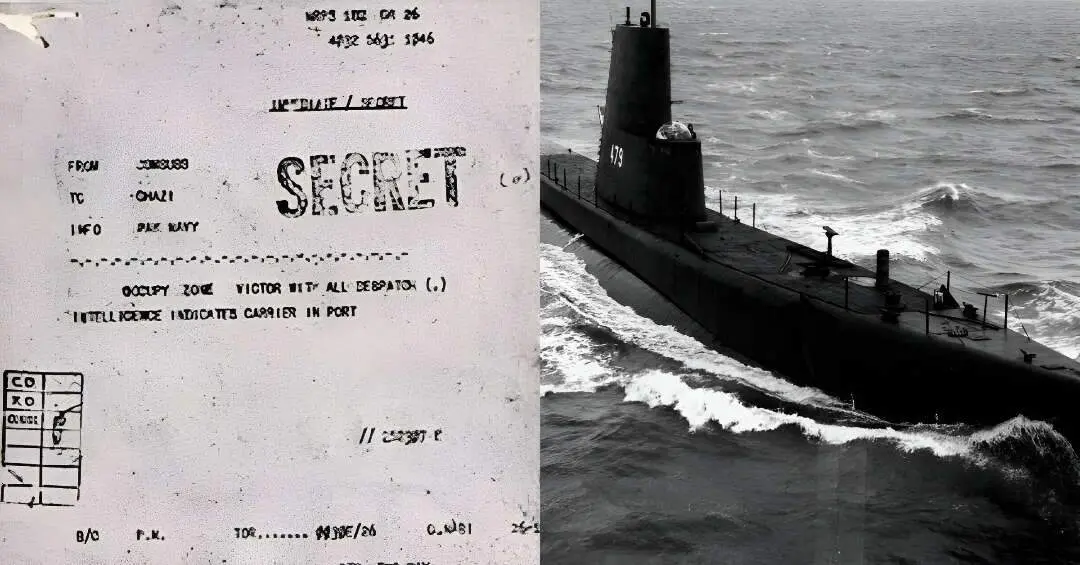
The top secret document indicating Vizag’s code name being ‘Zone Victor’ (Image credits: The Liberation Times)
When Indian Navy divers entered the shattered remains of PNS Ghazi on 7 December, the team retrieved several significant items: the ship’s navigational chart tracing its journey from Karachi, the captain’s notepad, the official logbook, radio transmissions, a Pakistani flag, and even the submarine’s distinct American-style curved “flying bridge” windshield.
Among the most telling discoveries was a top-secret document containing a clear directive: “Occupy Zone Victor. Intelligence indicates carrier in port.” It became evident that “Zone Victor” was Pakistan’s likely codename for Visakhapatnam, and the Ghazi had been sent on a high-stakes mission to strike what they believed was INS Vikrant.
7. The surprising role of Sampath Vinayak Temple
During the 1971 Indo-Pak war, Vice Admiral Krishnan of the Eastern Naval Command visited the Sampath Vinayaka Temple in Siripuram, Visakhapatnam, where he broke 1001 coconuts in prayer, seeking protection for the city against a possible attack from the sea. It was just days later that PNS Ghazi was destroyed.
8. The wreck of PNS Ghazi still lies near the coast of Visakhapatnam
The Ghazi still lies today in her watery grave, at the bottom of Visakhapatnam harbour. The United States once offered to recover the wreck, arguing that the submarine was originally American property. Pakistan also made a similar request. India refused both, asserting that the Ghazi entered Indian waters illegally during wartime. Today, the Indian Navy has chosen to leave the wreck undisturbed, treating it as a war grave and a final resting place for those who perished.
The sinking of PNS Ghazi marked India’s first naval victory over Pakistan, and it holds a special place in Indian military history. The Victory at Sea War Memorial in Visakhapatnam stands as a tribute to this event and to the courage of the Indian Navy. Today, the city of Visakhapatnam, the brave officers of the Indian Navy, and even local symbols like the Sampath Vinayaka Temple all have become part of the larger narrative of this incident.
Sources used:
An Immaculate Deception – Maddy (the piece presents excerpts and information from Admiral N Krishnan’s authored books “A Sailor’s Story” and “No way but surrender – An Account of the Indo-Pakistani War in the Bay of Bengal”
Submarine Sunk near Vizag: Indian Navy bags Pakistan’s navy pride by The Liberation Times
Boots On The Ocean Indian Navy by Satish Arora (Book)
1971: Stories of Grit and Glory from the Indo-Pak War by Ian Cardozo (Book)
Stay tuned to Yo! Vizag website and Instagram for more such articles.