On January 26, 1950, when India adopted its current constitution and became a republic making the Royal Indian Navy became the
Indian Navy. Its vessels were renamed as ‘Indian Naval Ships’, and the ‘HMIS’ ship prefix for existing vessels was changed to ‘INS’. At 9:00 that morning, the White Ensign of the Royal Navy was struck and replaced with the Indian Navy Ensign, symbolically completing the transition to the new Indian Navy. This transition marked a significant step in asserting India’s naval identity and sovereignty, reflecting the nation’s independence and command over its maritime forces.

Royal Indian Navy and Indian Navy Crest with Motto: शं नो वरुण
Geographically, India occupies a strategic position in South-East Asia. However, the coastline did not provide many harbours, and only a few good harbours. The chief of them before 1939 were Bombay, Calcutta, Cochin, Madras and Vizagapatam.
Following the opening of the newly constructed Vizag harbour in 1933, a naval base was considered, and the name TENGRA was reserved for the base. The history of the Visakhapatnam Naval Base dates back to the onset of World War II in September 1939. The necessity to have naval control on merchant shipping led to its first opening on December 12, 1939, as a Royal Indian Navy (RIN) base. HMIS CIRCARS (His Majesty’s Indian Service), then came into being on 12 April 1942 as a refitting and operational base largely because of a need to have such facilities on the east coast of India.
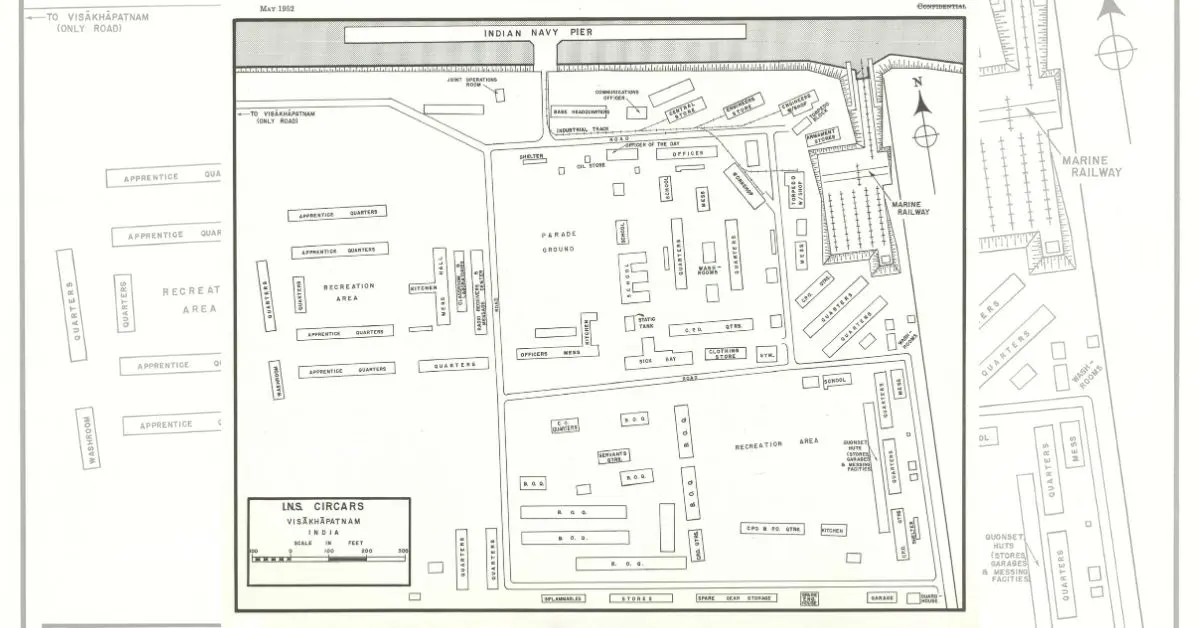
INS Circars Layout 1952
On March 1, 1945, a Royal Navy Shore Establishment under the name HMS AMZARI, a Landing Craft and Coastal Forces Base, was commissioned at Vizagapatam. Manned by 800 ratings and 50 officers, they were accommodated in an army constructed ‘tatti’ hutted camp. The sanitary and public health conditions of the camp were appalling, as it was a camp for over 2,000 Scindia Steam Navigation Company coolies and their families, adjacent to an open sewage drain and a breeding ground for flies and mosquitoes. The Naval Camp at Vizagapatam was condemned by the Naval Medical Officer of Health. Numerous improvements were instituted, but hygiene and sanitation never really became satisfactory. The camp was eventually increased to 2,000, and it was fortunate that the war ended and HMS Amzari closed down before any major medical disaster was encountered. The legacy of that time is still honoured in Amzari Park, which is the current Naval Officers’ Residential Complex.
At the outbreak of World War 2, HMIS Circars requisitioned the Port Tug ‘Sir Guthrie Russell’ for defence service and became the first vessel operated by the Navy in Vizag. The ‘Lady Craddock’, a fishing trawler of about 80 tons, was requisitioned and commissioned at Calcutta on 13 October 1939. After serving there on local naval defence duties until 17 September 1941, she left for Vizagapatam for a few days on mine-sweeping patrol and was the first commissioned naval vessel to operate from HMIS Circars. In 1944, the size of the naval base grew to 1364 ratings and 125 officers. Immediately next to Scindia shipyard, HMIS Circars had its own ‘haulage’ repair slipway (Marine Railway on layout) for repair of their small craft – the vessels being hauled up or glided down, moved sideways (transverse movement), with the help of a cradle transverser and a powerful shore-based winch.
In October 1939, the HMS Colombo became the first naval vessel to enter the port of Vizagapatam and visit HMIS Circars.
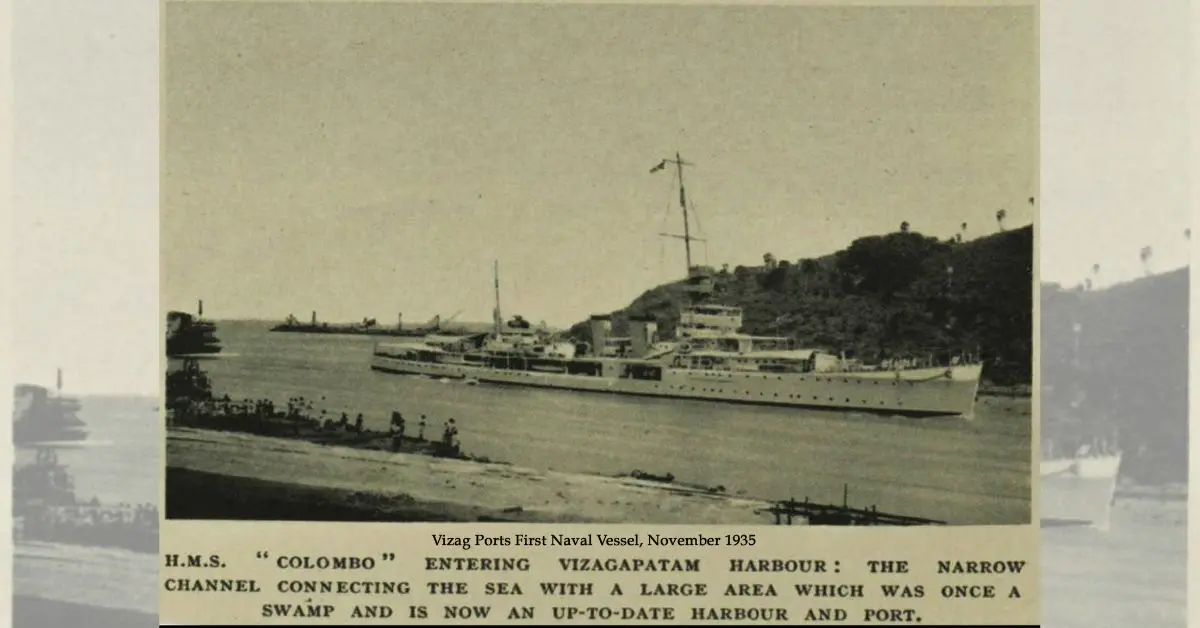
Vizag Ports First Naval Vessel, HMS Colombo, Nov 1935
In the early days of the war, a small stock of guns and ammunition was kept in the Naval Base under the control of the Base Gunnery Officer. Plans were made, however, as early as 1941 for the construction at Malakapuram of a small ammunition depot to store warheads and depth charges for the proposed RIN motor torpedo boat flotilla, which never actually materialised. In 1944, with increased work on coastal force craft, and with the formation of an RN landing craft wing, the Base Gunnery Officer had to take over the depot and hasten its completion in early 1945 with a storage capacity for 500 tons of ammunition, together with a gun workshop, offices and a non-explosives store building. With the largely increased ammunition requirements of the landing craft base, the Ordnance Export Transit Depot became known as the Naval Armament Depot (NAD).
Following Independence and a split of the naval fleet with the new Pakistan Navy, the Indian Navy, in 1949, gained the HMS Achilles which had fought the battle of the River Plate and sunk the German battleship Admiral Graf Spee in the early period of World War II. Renamed INS Delhi, she became the first flagship of the new Indian Navy to visit Vizag in 1950.
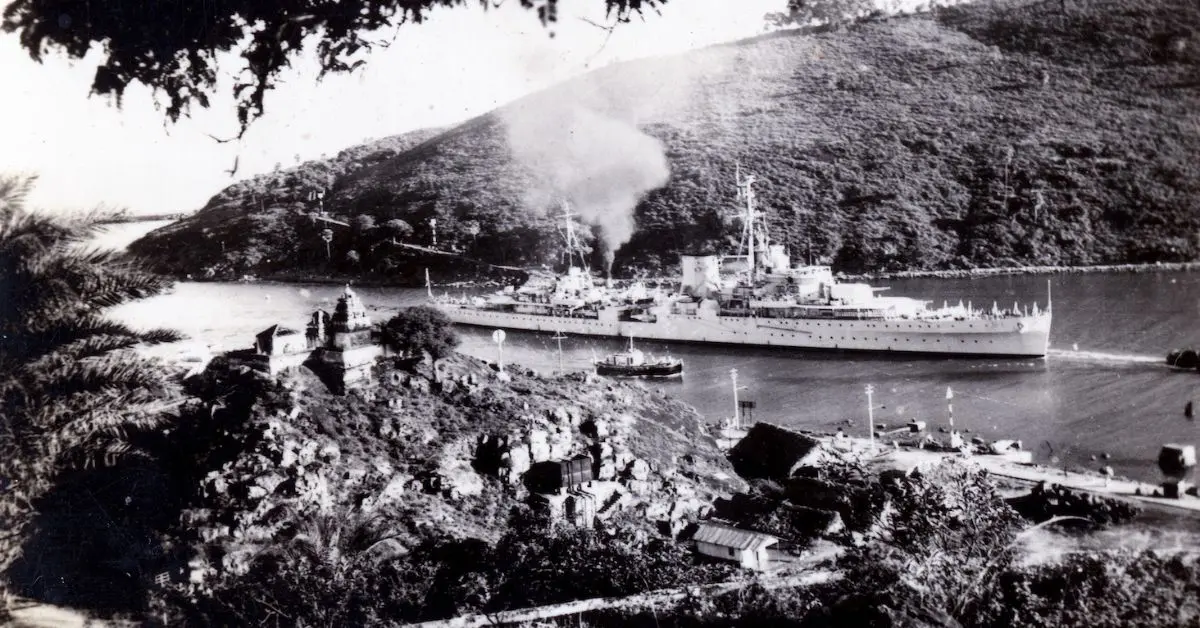
INS Delhi, Indian Naval Flagship, visits Vizag, 1950
Britain had been the traditional source of naval vessels for the Indian Navy, and it seemed likely that the UK would also be the source of India’s new submarine fleet when the HMS Astute was the first submarine to enter Vizag harbour in August 1965.

HMS Astute, First Submarine visits Vizag, August 1965
On 26 January 1950, the first Indian Governor General of India, Sri Chakravarti Rajagopalchari, announced the birth of the Republic of India to the accompaniment of a 31-gun salute. A few years later, he would write to the then Chief of Naval Staff recommending a motto for the Indian Navy: शं नो वरुण.

GG Sri Rajagopalchari’s letter recommending the Indian Navy Motto.
Adapted from the Sanskrit in the Vedas, the motto is translated to read ‘Varuna be auspicious unto us’. Varuna is the presiding deity of the waters and is also responsible for maintaining cosmic order. Today, INS Circars has grown from its humble beginnings in Vizag to be India’s Eastern Naval Command and this motto eloquently embodies our enduring respect for the maritime forces as we may well say to Vizag’s Indian Naval heritage – ‘Sam no Varunah’!
Written by John Castellas whose family belonged to Vizag for 5 generations. Educated at St Aloysius, migrated to Melbourne, Australia in 1966, former General Manager Engineering at Boeing & Qantas Airways, in retirement Lecturers in Aviation Management at Swinburne University and is a Vizag aficionado. John authors heritage articles for YoVizag and Waltair Times and has contributed to Coffee Table Books for the Waltair Club and Andhra Medical College. He can be contacted at [email protected]
Stay tuned to Yo! Vizag website and Instagram for more heritage articles.