Now Reading: Stories That Sing: Shobha Tharoor Srinivasan at the Vizag Junior Literature Fest
- 01
Stories That Sing: Shobha Tharoor Srinivasan at the Vizag Junior Literature Fest
Stories That Sing: Shobha Tharoor Srinivasan at the Vizag Junior Literature Fest

The LitLantern for Culture and Literature Welfare Society successfully hosted the sixth edition of the Vizag Junior Lit Fest at Hawa Mahal, Visakhapatnam, on November 8 and 9. The weekend was a vibrant celebration of imagination, discovery, and the joy of growing through stories. The festival’s core aim was to introduce children to the world of books and ignite a lifelong love for reading, literature, and language. The Lit Fest inspired children to imagine, be curious, and actively participate in a variety of activities, including storytelling sessions, theatre and performance art workshops, and interactive sessions with their parents, resulting in a well-balanced and enriching festival experience.
Voices Behind the Stories:
Yo! Vizag had the wonderful opportunity to speak with some of the most creative minds and inspiring voices from the world of children’s literature who headlined the LitLantern Festival in Vizag. These individuals are shaping the next generation through stories that inform, entertain, and empower.
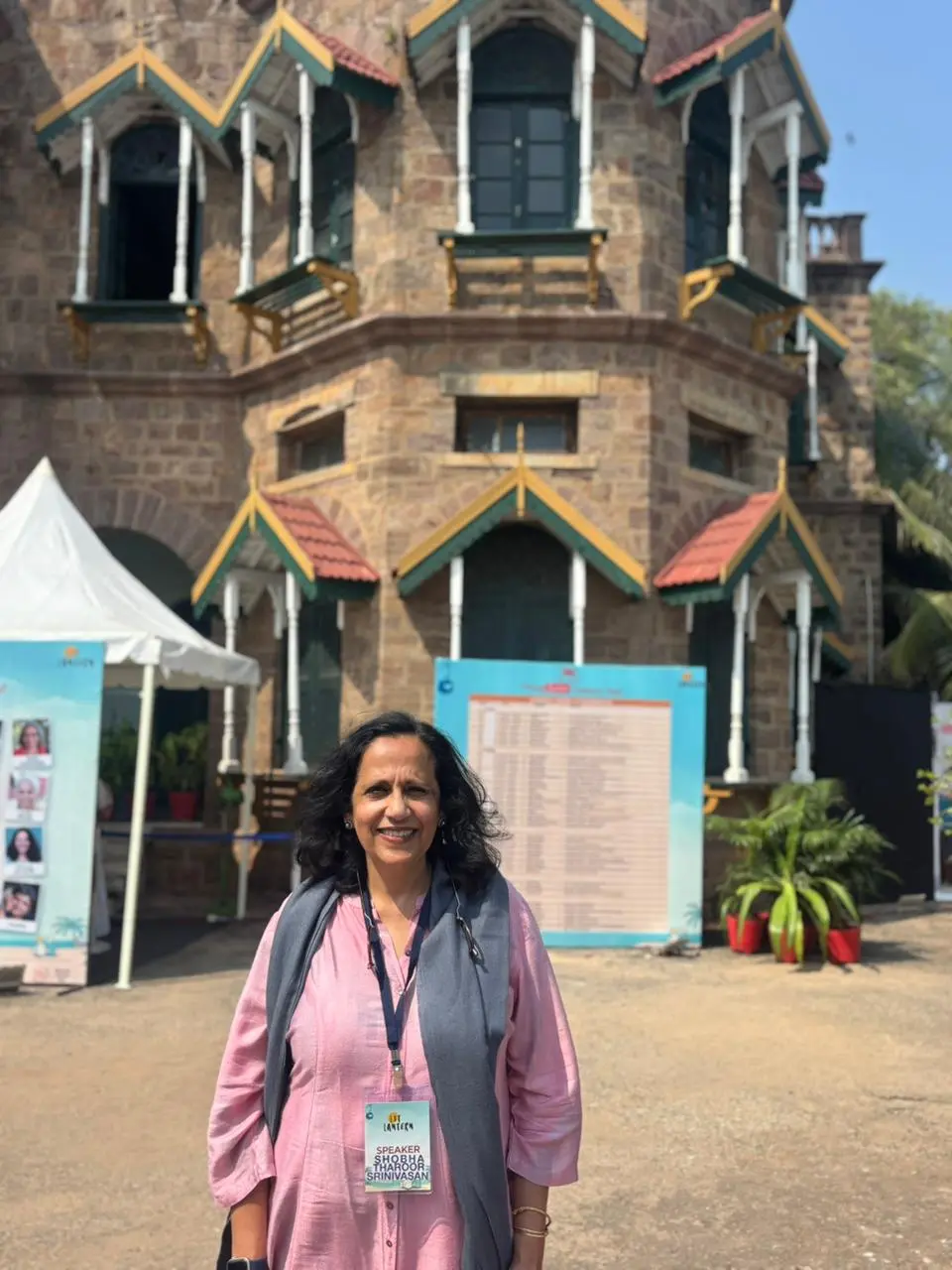
One such voice is Shobha Tharoor Srinivasan, who captivated audiences with her infectious passion for language and storytelling. An author, poet, and voice artist, her body of work celebrates both the sound and sense of words.
Exclusive Interview:
What follows is an insightful one-on-one conversation with Shobha, in which she shares her creative process, her multicultural influences, and what she hopes young readers will take away from her stories.
Interviewer: You’ve written across so many genres, ranging from poetry to children’s literature to essays. How do you adapt your voice for each?
Shobha Tharoor Srinivasan: That’s a wonderful question. I’ve written picture books, an illustrated biography, and two short story collections, apart from my poetry. My most recent book, Let’s Use Our Words, published by HarperCollins in August, actually combines all of that as it includes vocabulary-building exercises, activities, poetry, stories, and prose.
Two of my picture books are written in verse. I love the music of language. To be precise, its rhythm, cadence, and flow. I always read aloud. I tell the children to do the same; you catch the flaws in construction, its sound, and its emotional texture.
Interviewer: Tell us about your creative process, right from the spark of an idea to the finished book.
STS: My creative process isn’t conventional. Many of my ideas come from my interactions with children. Sometimes a child will compare poetry to math, and that sparks a new idea, motivating me to present poetry in fun and unexpected ways. That’s how my book, It’s Time to Rhyme, was born. It introduces poetic forms like sonnets and limericks in a playful, engaging style, and it even won an award! I love showing children that poetry can be joyful, surprising, and full of possibilities.
Interviewer: You conducted a poetry workshop at the festival. How did the children respond?
STS: It was delightful! We wrote simple forms like haikus and also explored the n’onet, a structure that was new to many of them. The kids were full of energy and curiosity. The Vizag Junior Lit Fest might be smaller in scale compared to some national events, but it’s equally spirited. Thanks to the organizers, volunteers, and young participants.
Interviewer: You’re also a celebrated voice artist and even a National Award winner. How do you approach storytelling through voice?
STS: Voice work isn’t just about having a good voice; it’s about delivery and emotion. My voice changes depending on the context of a commercial, a documentary, or a story narration. My National Award was for narrating Monsoons of Kerala, a documentary that remains close to my heart.
Interviewer: Having lived in both India and the U.S., how have multicultural influences shaped your writing?
STS: They’ve made me a global citizen. I’ve lived in the U.S. for years, but my roots are firmly Indian. My stories often reflect both worlds. When I first went abroad, I represented India among international peers, and that pride has never left me.
Even my writing style carries that mix. I wrote my first story at age ten, which my father secretly sent to a children’s magazine! I grew up in a word-loving family, with books instead of screens. Reading shaped me long before writing did.
Interviewer: Do you think South Asian stories are finding more representation globally today?
STS: Absolutely. There’s a growing movement for diversity in children’s publishing. Readers want to see themselves in the stories they read. So publishers are encouraging voices from varied backgrounds, what we call “BIPOC writers”. South Asian stories now have space, and they’re making an impact.
Interviewer: You come from a literary family. Has your brother, Dr. Shashi Tharoor, influenced your writing?
STS: Oh, yes! (laughs) I often tell children this story. Once, I came home from school and said I’d made a “nice” new friend. My brother said, “Nice is damning with faint praise, find a more expressive word!” That stayed with me forever.
He’s been a big influence, always encouraging me to choose the right words, to think deeply. He even supported my college application to the U.S., paying my application fees and cheering me on. Our relationship is rooted in mutual respect and literary curiosity.
Interviewer: What, in your opinion, makes a story timeless?
STS: A story becomes timeless when it resonates emotionally. While I’m writing, it’s my story, but once it’s published, it belongs to the reader. If even one person feels moved, seen, or comforted, the story has done its job.
Interviewer: What upcoming projects are you excited about?
STS: I have two books coming next year, one for adults—a poetry collection that explores love, loss, and identity—and another on Kerala folk tales for children, which I’ve categorized into myth, legend, origin stories, and local lore.
I also have two picture books on the way: Indie Alphabet, a reimagined travelogue through India, and A Day in Haiku, featuring 24 haikus capturing the rhythm of a day from dawn to dusk.
Interviewer: You’ve worked at the intersection of literature, education, and advocacy. How do these worlds connect for you?
STS: For over two decades in the U.S., I worked in disability advocacy, writing grants, and raising awareness for inclusion. That shaped my sense of purpose. Writing, to me, is another form of advocacy where words can change hearts and minds.
Even now, my children’s books carry values like equality, integrity, empathy, and environmental consciousness. I hope young readers see themselves as responsible global citizens; each of us is a small but vital part of this shared world.
Interviewer: Finally, what do you hope readers, young and old, take away from your work?
STS: That words are powerful. When used well, they can inspire, heal, and connect. I want children to understand that reading is the key to writing, and writing is the key to understanding ourselves and others.
The Vizag Junior Lit Fest 2025 was a heartwarming reminder that literature has the power to inspire even the youngest minds. Through initiatives like the LitLantern for Culture and Literature Welfare Society, children in Visakhapatnam are being given a platform to imagine, express, and grow.
As Shobha Tharoor Srinivasan speaks, her passion for words feels almost musical, like a symphony of rhythm, empathy, and purpose. Whether she’s crafting a children’s rhyme, narrating a documentary, or writing poetry for adults, her work carries the same message: that language can illuminate, connect, and heal.
Rooted in heritage yet global in vision, Srinivasan’s storytelling reminds us that the simplest words can hold the deepest truths.
Stay tuned to Yo! Vizag website and Instagram for more such articles.