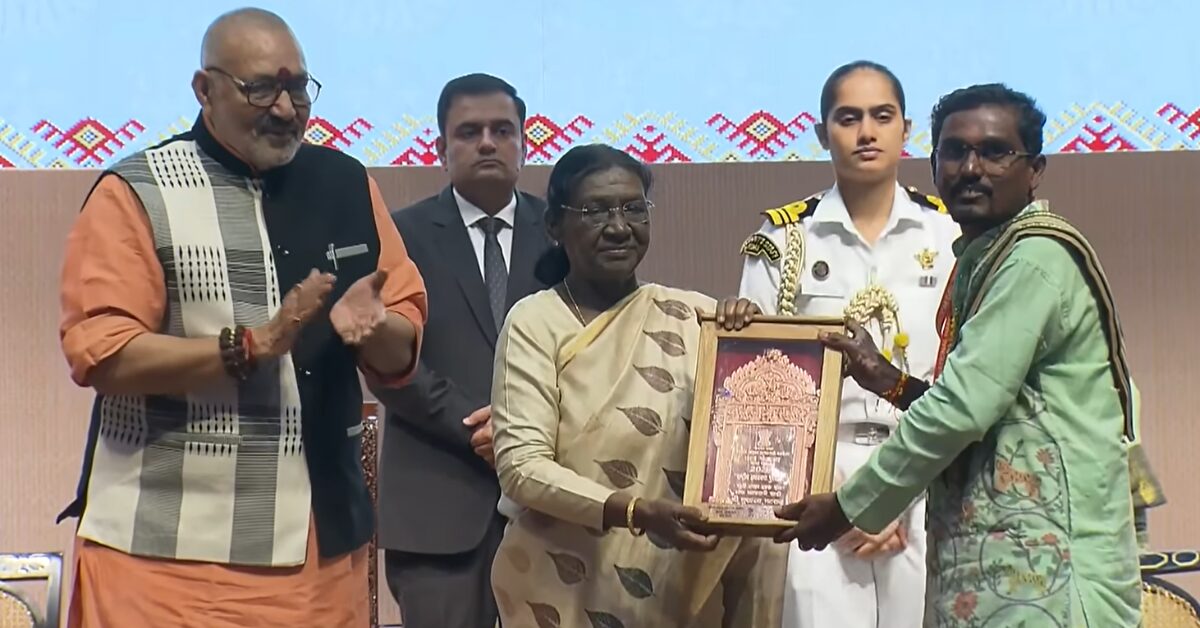
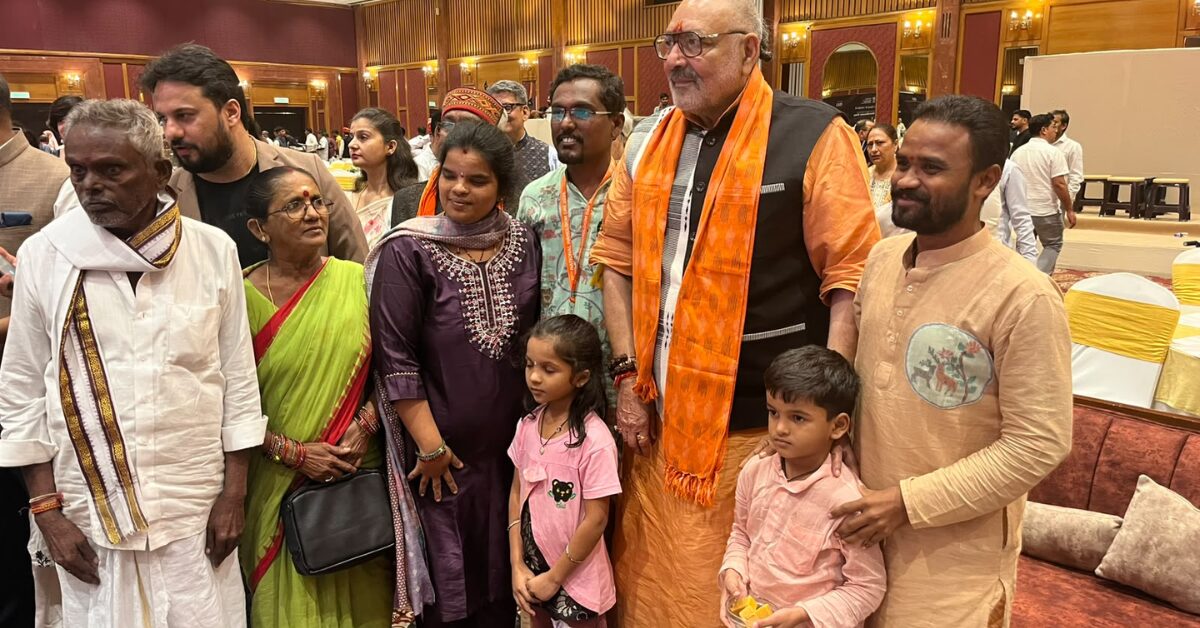
For many, a handloom saree is simply a beautiful piece of clothing. What is less visible is the skill, patience, and generations of knowledge woven into every thread. For Murakala Nataraju, a National Handloom Award winner from Alikam village in Srikakulam, handloom is more than a livelihood. It is an ancestral profession that he now hopes to make relevant to a generation increasingly drawn towards modern, machine-made clothing. In conversation with Yo! Vizag, here is what he had to say.
Nataraju grew up in a family of weavers, and his relationship with the loom began in childhood. He recalls waking up at around 3 AM, finishing his work and then leaving for school. The work initially began with traditional garments such as dhotis and shoulder cloth, before moving into sarees, including the seven-yard sarees commonly worn by women working in agriculture and other physically demanding occupations.
Over the years, Nataraju’s work has moved beyond simply reproducing traditional designs. His Jamdani weaving now incorporates flowers, trees, religious motifs and contemporary patterns, with the aim of making handlooms appealing to today’s customers.
For handlooms to survive, he believes that weavers have to understand what today’s customers want. “What design would look good today? What attracts today’s youth? We have to change our perspective and design accordingly,” he explains. His work incorporates Tussar, Zari, and combinations such as Tussar-khadi and half-and-half styles. Experimentation, he believes, is necessary if handloom is to remain commercially relevant.
Nataraju’s description of weaving reveals just how much precision goes into creating a piece by hand. “We create the cloth with our minds first,” he says, pointing out that machinery is developed by replicating processes originally created through human skill.
He speaks particularly about fine yarn counts, including 200-count yarn, which he describes as thinner than a strand of hair. Nataraju recalls working on a saree sample for nearly two years because he wanted the final design to meet his expectations. Much of this knowledge, he says, remains unfamiliar to consumers, who may assume that intricate designs are machine-made.
He compares the situation to established clothing brands that have invested heavily in advertising and built strong recall among consumers. Traditional handloom weavers, however, often do not have the same marketing visibility.
Just as people are beginning to question how their food is grown, Nataraju believes they may also begin asking how their clothes are made. For him, this represents an opportunity for handloom.
“We don’t have to wear it every day. Even wearing it during an occasion can make a difference,” he says. Nataraju points to the Jamdani attire he wore while receiving the National Handloom Award as an example of how traditional weaving can still make a statement in the present day.
For him, the biggest concern is whether there will be enough people left with the knowledge to make handlooms. Over the years, many members of traditional weaving communities have moved to cities in search of employment. The decline is particularly worrying because some of the earliest stages of the process, including traditional cotton spinning, are themselves becoming less common.
In Srikakulam, Nataraju is already providing employment to people from different backgrounds. His aim is to build a wider ecosystem around handloom rather than confining the craft to a community. He says the initiative has opened opportunities for women entrepreneurs through Self-Help Group programmes and other avenues.
Nataraju is quick to point out that he does not view the National Handloom Award solely as a personal achievement. He credits the support of the Weaver Service Centre in Vijayawada, the Vijayawada Commissioner’s Office, the Commissioner of Handlooms and Textiles Smt. Rekha Rani, the Srikakulam Handloom Assistant Director’s office, public representatives, handloom families and people across the state. Above all, he says, it was God’s grace that carried him through.
Nataraju’s message to consumers is straightforward: wear handloom, support the people who make it and take the time to understand the labour behind it. The goal, he says, is not to turn the clock back completely. The younger generation may not abandon modern fashion, and there is no need to. But what matters is finding space for tradition alongside it. Nataraju’s own journey demonstrates that tradition survives by learning how to evolve.
Also read: Yo! Exclusive: The Story Behind the Tiranga Flags That Soared to Guinness Heights
Stay tuned to Yo! Vizag website and Instagram for more such articles.
About 30 students of the Political Science and Public Administration Department of Andhra University, led…
State IT and HRD Minister Nara Lokesh has made it clear that there will be…
Panic gripped residents after four skeletal remains and nine skulls were recovered from heaps of…
Chaired by Chief Minister N. Chandrababu Naidu, the Andhra Pradesh Cabinet, at its meeting on…
For Vizagites looking to explore a different side of Andhra Pradesh without travelling too far,…
It's that time of the week to update your watchlist! OTT platforms like Amazon Prime Video,…